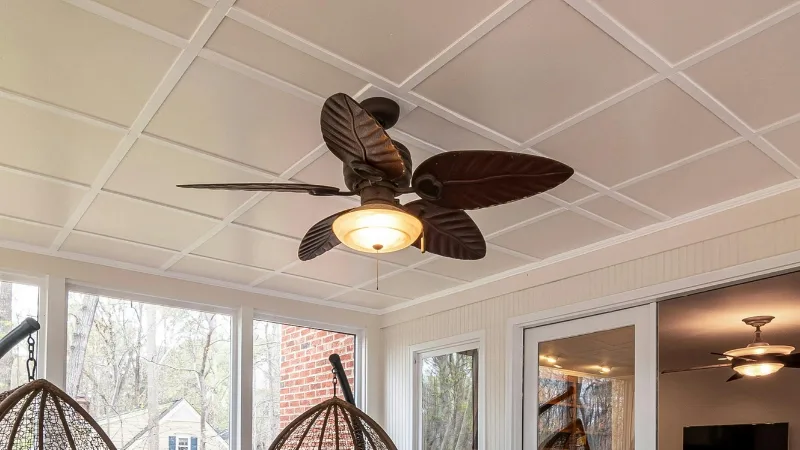
The AC vs DC ceiling fan choice is price against running cost: DC costs a bit more upfront but uses less power, runs quieter and offers more speeds, while AC is generally cheaper. The saving shifts with fan speed, sits below the headline figure on most settings and rarely justifies pulling down a working AC fan. The bigger catch is on the wall, because an old AC speed knob won't run a DC fan.
I'm Brian Ho, a licensed electrician, and at Powerhub Electrical St Ives we install AC and DC ceiling fans in homes across St Ives and the Upper North Shore. This guide covers what a DC fan really saves on power, which wall controls work with each motor type, and when switching from AC to DC is worth it.
AC and DC Ceiling Fans Explained for St Ives Homes
Both motor types spin the same kind of blades, so why does one cost more to buy, less to run and need its own wall control? The answer sits inside the motor housing:
How an AC Ceiling Fan Runs
AC motors used to be more common, so you'll likely find them in existing installations, and CHOICE's buying guide says they generally have cheaper options, with more models under $200. A fan that came with the house is one clue in how to tell if a ceiling fan is AC or DC.
Hunter Pacific's Concept AC 132 cm is one example. Its Concept AC spec sheet lists a three-speed wall control that uses speed capacitors, plus a summer/winter reverse switch on the motor itself. On that range, a remote is an optional accessory bought separately.
What Sets a DC Ceiling Fan Apart
What is a DC ceiling fan, exactly? Its motor runs on direct current, and CHOICE explains that an internal rectifier lets it work on a normal household AC supply. DC fans are now the most common type of ceiling fan, though they can cost a bit more upfront.
On the same range, the Concept DC spec sheet lists a six-speed remote with sleep mode, summer/winter reverse from the remote and an optional DC wall control. Those motor differences show up on the power bill, which is where the efficiency claims start to disagree.
AC vs DC Ceiling Fan Running Costs for Ku-ring-gai Homes
Energy NSW rates DC motor fans 70% more efficient than AC and says to choose one where possible. YourHome's guidance puts DC at half a traditional fan's energy, and tested costs tell a third story:
What CHOICE's Running Cost Tests Found
CHOICE's testing puts the average AC fan at $25 a year to run, with the cheapest at $20 and the dearest at $47. DC fans average $17, ranging from $11 to $23, assuming eight hours a day for six months of the year at 40 cents per kWh. The ranges overlap, with the cheapest AC fan undercutting the dearest DC fan, and the averages sit about $8 apart.
CHOICE also advises against getting rid of your old fan just to save a couple of dollars a year. Efficiency still counts when you're buying anyway: Ku-ring-gai Council says electricity use makes up over half of Ku-ring-gai's carbon emissions, and that the area is the third-highest electricity user in Sydney.
Checking the 70% Efficiency Figure Against Spec Sheets
Hunter Pacific's matched 132 cm Concept AC and Concept DC spec sheets list watts, not percentages, so the percentages here are our own calculation. On high, the DC draws 34.8 W against 62 W for near-identical top airflow (14,198 and 14,096 m³/h), about 44% less. At a matched airflow of about 6,990 m³/h it's 12.6 W against 26 W, roughly half, and on the lowest setting 3.9 W against 12.5 W, about 69% less.
On this pair, Energy NSW's figure fits the bottom of the speed range and YourHome's estimate the middle, though other brands will differ. The power-bill gap is a few dollars a fan each year, while at low speed on this spec sheet it nears 70%.
DC Ceiling Fan with Wall Control Options in St Ives
Swap an AC fan for a DC model and the speed knob that ran it for years can't come along. What replaces that wall controller depends on the brand and model:
Old AC Wall Knobs and Dimmers on DC Fans
On the Concept AC spec sheet, the wall knob is a capacitor-type speed control, with its capacitor values listed. A DC fan takes its speed from its own receiver instead, set by the remote or a DC wall control.
Hunter Pacific's manual says not to use solid-state wall controllers, because neither leading- nor trailing-edge types perform satisfactorily, and to fit only wall controls it approves, since unapproved ones may void the warranty. CHOICE also notes that a conventional round wall dimmer can make the motor hum in some fans with light mounts.
When a DC fan goes in, the old knob comes out or makes way for an approved control.
Matched DC Wall Controls and Isolation Switches
A DC ceiling fan with wall control in Australia is possible, but the control must match the fan. Hunter Pacific's DC wall control suits only selected fans in its DC range, the Concept DC among them, and works in tandem with the remote.
The Concept DC installation manual limits one DC wall controller to two fans in the same room, each with its own receiver. It also requires an electrician-supplied isolation switch for full disconnection of fan and light, and that switch, not the handset, cuts mains to the DC control module.
Make that switch part of any ceiling fan installation quote, and before you buy, check the manual lists a DC wall control for your exact model.
DC vs AC Ceiling Fan Features Side by Side
Every difference that matters fits in one table, so you can check any fan's box or spec sheet against these rows before you buy either type:
| Feature | AC ceiling fan | DC ceiling fan |
|---|---|---|
| Upfront price | Generally cheaper, more budget models | Costs a bit more upfront |
| Average running cost | $25 a year | $17 a year |
| Power on high (Concept 132 cm pair) | 62 W | 34.8 W |
| Speed settings | 3 | Up to 7 (6 on the Concept DC) |
| Wall control | Capacitor-type speed control | Model-matched DC wall control, optional |
| Summer/winter reverse | Switch on the motor | From the remote |
| Breeze mode | Less common | Becoming more common |
The price, running cost, speed and breeze rows come from CHOICE's buying guide. Wattage, control and reverse details are from the Concept AC and Concept DC spec sheets, and other brands differ, so check the exact model's sheet.
YourHome's advice says DC fans are generally quieter, and that fans suited to bedrooms typically have very gentle speed settings. On Hunter Pacific's sheets, the Concept DC moves 3,990 m³/h on its lowest speed against 4,986 m³/h on the Concept AC low setting. That's one model pair, not a rule for every DC fan.
A humming fan isn't always faulty. CHOICE points out that ripple-control signals on the supply, used to switch off-peak loads like hot water, can cause it, and Hunter Pacific lists ripple filters as accessories for its AC fan. Hum that persists is a job for electrical fault finding.
Energy NSW suggests features like a remote, dimmable LED lights and a reversible motor, plus a DC fan that connects with your system in smart homes. Fans with lights tie into lighting installation too, and which difference matters most depends on the room.
The Verdict on AC or DC Ceiling Fans for the Upper North Shore
A DC fan costs less to run, yet a working AC fan rarely needs to come down. The right pick depends on the room, the fan's daily hours and how you want to control it:
- Your AC fan still works: keep it, because the running-cost gap doesn't justify early replacement. If it has developed a fault, have it checked through our electrical repairs service before deciding.
- You're fitting a new fan or replacing a dead one: go DC. When it's a DC or AC ceiling fan for a new room, DC wins on running cost, speed settings and quieter operation.
- You want a switch on the wall: choose a DC model whose manual lists a matched DC wall control, or stay with AC to keep the existing capacitor wall control.
- Bedrooms and smart homes: lean DC, for quieter running, more speed settings and the option of a fan that connects to your home system.
Whichever motor you pick, Energy NSW says a licensed electrician must install it, using a ceiling box rated for the fan's weight and vibration. Skip that on a Hunter Pacific fan and its installation manual says on-site warranty claims won't be accepted, so book our electricians or another licensed installer.
Conclusion
DC fans clearly draw less power than AC fans, but the saving per fan depends on its speed and daily hours, and on most settings it sits below the headline figure. On a household bill that's a few dollars a fan each year, not a reason to pull down fans that still work.
The wall control deserves as much thought as the motor. An old AC speed knob or dimmer can't drive a DC fan, any DC wall control has to match that exact fan model, and the installer fits an isolation switch so the fan can be fully disconnected.
Keep a working AC fan until it fails, and choose DC whenever you're buying a fan anyway.
Areas We Service
We install AC and DC ceiling fans for homes around St Ives, including Pymble, North Turramurra, South Turramurra, Terrey Hills and Chatswood. Before a new DC fan goes up, we check whether the existing wall control suits the motor you've chosen, so the switch on your wall works with the fan above it.
Book Your Ceiling Fan Installation in St Ives
Call Powerhub Electrical St Ives on 0400 332 331 to book an AC or DC ceiling fan installation or a wall-control upgrade, or send the details through our contact form:
- $50 off your first service
- 15% pensioner discount
- Free 5-star electrical safety inspection with every booking
- Obligation-free, upfront quotes
- Licensed electrical contractor (Licence No. 467291C)
Frequently Asked Questions About AC and DC Ceiling Fans
How do I know if my ceiling fan is AC or DC?
Check the manual or product label first. On some ranges, such as Hunter Pacific's Concept fans, a reverse switch on the motor and a wall speed knob suggest AC, while remote reversing suggests DC.
Do DC ceiling fans need special wiring?
No separate DC supply is needed, because an internal rectifier lets them run on normal household power. They still need an isolation switch, and some DC wall controls need only mains at the switch.
What happens if I lose my DC ceiling fan remote?
A replacement handset can be paired to the fan's receiver, and Hunter Pacific allows two handsets per fan. Some DC models also offer a matched wall control as a backup.
Do ceiling fans have an energy star rating?
No. Ceiling fans aren't among the products on the Government's Energy Rating regulated list, so there's no government star label to compare. Check the watts listed for each speed on the spec sheet instead.
Does Ku-ring-gai Council offer a rebate for ceiling fans?
Not on Council's current Energy Smart rebate list, which covers items such as solar, batteries, induction cooktops and insulation. Energy NSW lists Home Energy Saver zero-interest loans as an option for installing ceiling fans.
Can I swap an AC ceiling fan for a DC fan myself?
No. In NSW, installing or replacing a ceiling fan is licensed electrical work and DIY electrical work is illegal. Hunter Pacific also refuses on-site warranty claims on fans installed by unlicensed people.