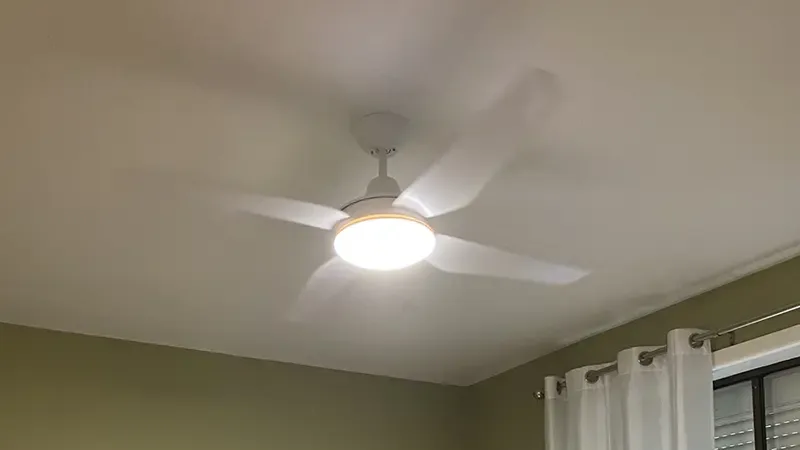
Set your ceiling fan to spin anticlockwise in summer and clockwise on its lowest speed in winter, both judged by looking up from directly underneath. That's ceiling fan direction for summer and winter in one line: summer sends a cooling breeze down onto you, while winter moves warm air around gently, without a draught. Don't trust the switch label to tell you which mode you're in, because the airflow is the real test.
I'm Brian Ho, and at Powerhub Electrical St Ives we install ceiling fans and track down faults when one won't reverse. This guide covers which way to set your fan each season, why winter mode works without a breeze, how to check the airflow rather than the label, and how to pair it with air conditioning or a heater.
How Fan Direction Moves Warm and Cool Air in St Ives Homes
If winter mode pulls air up towards the ceiling, how does it warm anyone sitting below it? The answer explains both settings, and why so many fan guides seem to contradict each other.
Written by the Australian Government, the YourHome guide explains both modes. Under summer settings, a fan forces air downward over the people in the room, which gives the strongest wind chill effect. Winter settings draw cool air upward instead, displacing the warm air that has naturally risen and pushing it sideways and gently down the walls with minimal wind chill.
Hunter Pacific's Concept manual describes the same winter path: air is drawn up the centre of the fan, pushed along the ceiling, then circulated down to the living areas. So "up" and "down" are both right. Winter mode lifts air through the middle and sends the warm layer down the walls, which is why it feels like almost nothing is happening.
Printed labels are a different story. One Fanco manual, for its Urban 2 AC model, says to set the switch to Forward in the warmer season so the blades turn clockwise, and to Reverse in cooler seasons for anticlockwise, the opposite of the Hunter Pacific wording above. So trust the airflow, not the label, starting with the season that's almost here.
Ceiling Fan Direction for Summer in Ku-ring-gai
A fan costs only about 2 cents an hour to run, according to Energy NSW, and the same advice says it can make the room feel about 3°C cooler on its summer setting.
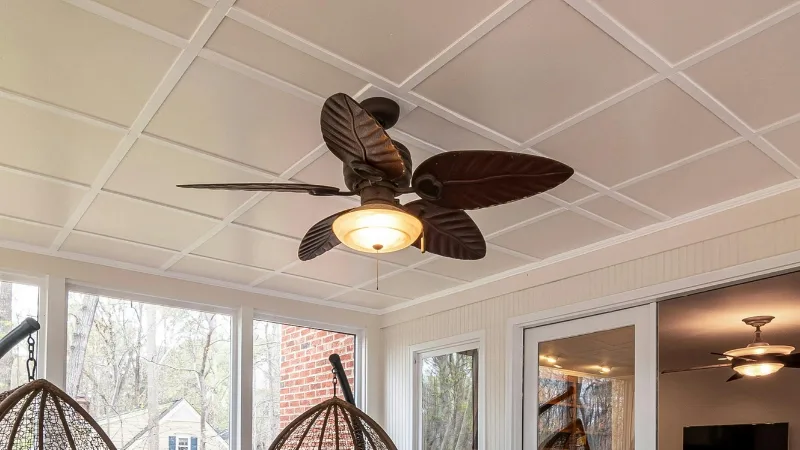
That summer setting is anticlockwise. Energy NSW's guidance says a fan spinning anticlockwise in summer creates a cooling effect, so the summer fan direction is anticlockwise when you look up from directly underneath. Get the rotation right and the blades push a steady stream of air down over the couch or bed, and that moving air on your skin is what you feel as cooling.
Ku-ring-gai summers give a fan plenty of work. Bureau of Meteorology figures from its Terrey Hills station, in a suburb within our service area, show mean maximums of 25.6°C in December, 26.6°C in January and 26.0°C in February. Those are averages, so individual afternoons run hotter.
Direction only helps while someone is sitting or sleeping under the fan. Energy NSW says fans move air to make you feel more comfortable without changing the room's temperature, and it advises switching the fan off when you leave, because fans cool people, not rooms. A fan left spinning in an empty bedroom cools nobody and still draws power.
Ceiling Fan Winter Mode on the Upper North Shore
The heater runs all evening, yet your feet stay cold, because warm air naturally rises and collects up near the ceiling, well above the couch where you're actually sitting.
That gap matters on the Upper North Shore, where winter nights get cold. The Bureau's Terrey Hills station averages minimums of 8.7°C in June, 7.9°C in July and 8.7°C in August, so the right winter fan direction has a full season of work to do.
Energy NSW says to run the blades clockwise on the lowest speed in winter, to circulate warm air gently without creating a draught. So if you can barely feel the fan in winter mode, it's doing its job. A noticeable breeze means the speed is too high or the fan is still on its summer setting.
No reverse switch? CHOICE home expert Denis Gallagher says a fan in normal mode still moves warm air down, but the downward blast isn't particularly comfortable in winter. He adds that it really needs to be a ceiling fan, up where the warm air is, so a pedestal fan won't do the same job.
The lasting fix is a fan with summer and winter settings, as the YourHome guide recommends, and Energy NSW says a licensed electrician must install it. Our ceiling fan installation service handles that, and lighting installation covers a light kit if you want one. If your fan can't reverse and winter evenings drag, have a reversible one fitted before next June.
How to Check and Change Ceiling Fan Direction
One look from directly beneath the fan tells you which mode it's in. Flipping the setting is a homeowner job, while anything touching the wiring belongs with our licensed team:
Check the Airflow, Not the Label
To tell clockwise from anticlockwise, stand directly under the fan and look straight up. Anticlockwise blades mean the summer setting and clockwise means winter, using the same "viewed from underneath" reference as the Hunter Pacific manual. That manual also says winter mode draws air up the centre of the fan, so you shouldn't feel much below it.
Now turn the speed up and stand still for a moment. A clear breeze on your face means summer mode, while very little direct airflow means winter. If the label on the switch disagrees with what you feel, believe the breeze, and make the change a habit when daylight saving starts and ends.
Find the Reverse Switch or Remote Button
On an AC fan, look for a reverse switch on the fan itself. Fanco's Urban 2 manual says to set the fan to off and wait until the blades are still before changing direction.
A DC fan works differently. Hunter Pacific's Concept DC manual puts a Forward/Reverse button on the remote and says you can use reverse any time, though depending on speed the fan may take a little while to stop and change direction.
Push the switch fully into one position, because Hunter Pacific's troubleshooting says to check exactly that when a fan won't start. If the fan still won't start or reverse after that, electrical fault finding traces the cause and electrical repairs put it right. With the rotation sorted, pair it with your cooling or heating.
Using Ceiling Fans with Air Conditioning and Heaters in St Ives
Using fans with occasional air conditioning can cut energy use by up to 76% compared with using an air conditioner, according to Energy NSW. Here's how to set each season:
Summer Mode with Air Conditioning
Energy NSW's tips put the fan first: run it on the anticlockwise summer setting before reaching for the air conditioner. When the air conditioner does go on, set it between 23 and 26°C, because every degree higher can save about 10% on your air conditioning bill.
That gives a simple order for a hot afternoon. Start with the fan, add the air conditioner only if the fan isn't enough, and keep the set point at the warmer end of that range with the fan still running anticlockwise overhead. The breeze on your skin does part of the work, so a warmer set point still feels comfortable.
Winter Mode with a Heater
Energy NSW suggests a heater setting between 18 and 21°C. It also says every degree lower can save about 10% on your heating bill.
In one CHOICE lab test, a convection heater used 1.67 kW to hold 18.5°C. With the ceiling fan running in reverse, the heater needed just 0.70 kW for the same temperature, and the fan itself used 0.009 kW. Together they drew less than half the power of the heater alone, though that was one test with one heater.
Run the heater alone and the warmth pools overhead. Add a slow fan in reverse, and that warmth comes back down to the people it's meant for.
Conclusion
Ceiling fan summer and winter mode comes down to three points. Looking up from beneath, the blades should turn anticlockwise through the warm months and clockwise through the cold ones, with winter kept to the slowest speed. Summer relies on the breeze reaching your skin, so switch the fan off when the room empties.
Winter mode is subtler by design. It lifts the cooler air through the middle and sends the ceiling's trapped warmth back down the walls, so feeling almost nothing is the sign it's working. When a printed label and the airflow disagree, trust the airflow, then let the fan share the load with a sensible thermostat setting in both seasons.
Areas We Service
We install and repair ceiling fans for homes across St Ives Chase, Wahroonga, Warrawee, Roseville, East Killara and neighbouring suburbs. Whether your fan won't change direction or you want a reversible fan fitted, we check the switch, controller and wiring, then give you an upfront quote before any work starts.
Book Your Ceiling Fan Installation in St Ives
Call Powerhub Electrical St Ives on 0400 332 331 to fit a reversible ceiling fan in your St Ives home or find out why your current fan won't change direction:
- $50 off your first service
- 15% pensioner discount
- Free 5-star electrical safety inspection with every booking
- Obligation-free, upfront quotes
- Licensed electrical contractor (Licence No. 467291C)
Frequently Asked Questions About Ceiling Fan Direction
Which way should a ceiling fan spin in summer in Australia?
Anticlockwise, viewed from directly underneath the fan. The direction doesn't change in the southern hemisphere, and the summer setting pushes a steady breeze down onto the people sitting below.
Should a ceiling fan push air up or down?
Down in summer, so you feel the breeze. In winter, it draws cooler air up through the centre and pushes the warm air from the ceiling sideways and down the walls towards you.
Is fan direction just a myth?
No. A fan doesn't change the room's temperature, but its direction decides whether you get a cooling breeze in summer or gentle, draught-free circulation of warm air in winter.
Do I need to turn off a ceiling fan before reversing it?
Yes for an AC fan: turn it off and wait until the blades are still. A DC fan's remote can reverse it while running, though the fan slows and stops before changing direction.
Should a ceiling fan run on high or low in winter?
Low. Run it clockwise on the lowest speed so it circulates warm air gently without creating a draught. If you can feel a breeze in winter mode, turn the speed down.
Is winter mode worth using in a St Ives home?
Yes. Upper North Shore winter nights get cold, and winter mode brings heater warmth down from the ceiling. In lab testing, pairing a heater with a reversed fan cut the heater's power use sharply.