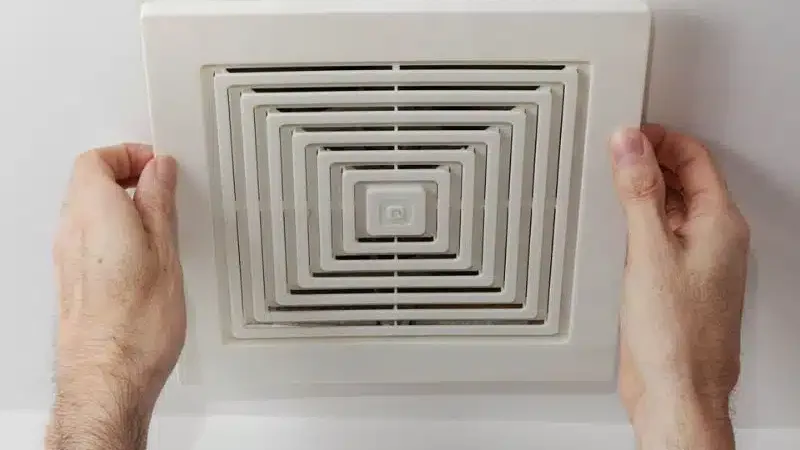
Repair the fan when the fault sits in the switch, run-on timer, wiring or duct, and choose a bathroom exhaust fan replacement when the motor or the unit itself has failed. A replacement is also the moment to fix a long or sagging duct run, so the new fan isn't held back by it. Cleaning the grille is the only hands-on job for an owner, and everything behind it belongs with a licensed electrician.
I'm Brian Ho, director of Powerhub Electrical St Ives, where we diagnose, repair and replace bathroom ventilation fans. This guide covers the safe owner check, how ducting changes a fan's real airflow, and the NCC Housing Provisions figures for new bathroom exhaust, from 25 L/s and outdoor discharge to a 10-minute run-on timer in rooms without natural ventilation.
Signs of a Failing Bathroom Exhaust Fan in St Ives Homes
The mirror is still fogged long after your shower, and the fan above it is either droning away or has gone completely quiet. Each sign below points to a different kind of fault:
- Silent when switched on. No sound at all tells your electrician to check whether power reaches the fan.
- Humming, but the blades don't turn. A hum means power is reaching the motor, so attention shifts from the switch to the fan.
- Running, but steam lingers. A fan that spins yet leaves the room foggy has an airflow problem rather than a dead motor.
- Rattling, catching or draughty. New rattles, blades catching the cover, or cold air and roof-space debris dropping through an idle fan all deserve a closer look.
The ABS 2021 Census puts the average St Ives household at 2.9 people, above the NSW average of 2.6. With more people per home than the state average, it pays to check the fan in every bathroom, not only the main one, then match what you notice to the causes below.
Common Causes of a Bathroom Fan Not Working
Martec's Saturn spec sheet rates the fan at up to 89 L/s, but says its capacity figures are based on the unit free-flowing, not ducted. Four faults can stand between that rating and your bathroom:
Dust Build-Up on the Grille
Dust is the simplest cause and the easiest to spot, since it collects on the grille in plain view. IXL's Ventflo guide says to keep the inlet grille free from dust for optimum airflow, and its warranty excludes damage caused by a build-up of foreign matter such as dust and moisture.
If the grille looks grey and furry, start there. It's the one hands-on check you can safely do yourself, and the next section explains how to do it without touching anything electrical.
Long or Crushed Exhaust Fan Ducting
A ducted exhaust fan is only as good as the duct behind it. Martec's Flow 250 manual says the shortest, smooth-surface duct with the fewest elbows gives the best fan performance.
A long run, flexible duct that sags or kinks, or a duct that has slipped off the fan outlet all cost real airflow. None of it is visible from the bathroom, which is why your electrician checks the exhaust fan ducting in the roof space rather than asking you to climb up there.
Missing Make-Up Air and Roof-Space Discharge
Every litre of air a fan pulls out has to be replaced from somewhere. For a bathroom relying on an exhaust fan rather than natural ventilation, the NCC condensation management clause calls for make-up air through a 14,000 mm² opening to an adjacent room or compliance with AS 1668.2, and gives a 20 mm undercut on a 700 mm wide door as an example. The same clause says bathroom exhaust must discharge directly, or via a shaft or duct, to outdoor air.
Both describe what the code expects of new work. A duct stopping in the roof space falls short of that benchmark, and a replacement is the natural time to extend it outside.
Motor, Switch and Timer Faults
Silent or humming is the first clue. An exhaust fan not working at all, with no hum, points your electrician toward the supply or the switch, while a hum points toward the motor. A faulty run-on timer can also cut the fan off early or stop it starting.
Every one of these sits behind the grille, so it's a job for electrical fault finding. Fit a new fan without finding the cause, and it inherits the same blocked duct or wiring fault as the old one.
Safe Bathroom Exhaust Fan Checks for St Ives Homeowners
Two checks need only a glance at the switchboard and a soft cloth, and the third simply means watching the fan closely before you call anyone:
- Look at the switchboard. See whether a circuit breaker or safety switch has tripped, open nothing, and tell your electrician.
- Do only the exhaust fan cleaning your manual allows. Turn the power off, follow the manual for the cover and keep water away from the motor. IXL's Ventflo guide says the fascia can be wiped with a damp cloth or dusted with a soft bristle brush.
- Note what the fan does. Silent, humming, rattling or draughty, that detail speeds up diagnosis.
NSW Government guidance says that unless you're a qualified electrician, you should never carry out any electrical maintenance other than changing a light globe. Even for a fan with a plug, Martec's Flow 250 manual says installation is for a licensed electrician, and so is any interconnecting wiring or switch. If the grille is clean and steam still lingers, call our licensed team.
Choosing Between Exhaust Fan Repairs and Replacement in St Ives
Why scrap a whole fan over one part? IXL's Ventflo guide says its power cord can't be replaced, so a fan with a damaged cord should be scrapped. The failed part decides the rest:
When Exhaust Fan Repairs Make Sense
Exhaust fan repairs make sense when the fan itself is sound and the fault sits around it. That covers a faulty wall switch, a run-on timer that has stopped working, damaged wiring, a duct that is blocked, crushed or has come loose, and a bathroom starved of make-up air.
None of those needs a new fan. Reconnecting a slipped duct or replacing a failed switch puts the existing unit back to work.
Our electrical repairs service covers the switch, timer, wiring and duct, and I'll point out a make-up air problem if the room has one. I'd always rather fix what's actually wrong than fit a fan you don't need.
When a New Fan Is the Better Call
Replacement is the answer when the motor has failed or the unit is damaged, and Martec's Saturn spec sheet says not to attempt to open and repair the product. The same sheet's capacity figures assume no ducting, so a fan that can't clear steam once ducted needs more headroom, a shorter duct run, or both.
Warranty counts too. Martec's Flow 250 manual gives a 2-year replacement warranty, but says claims will be voided unless the installer's certificate of safety can be produced when required.
Every bathroom fan replacement through our exhaust fan installation service is tested before handover. Repair keeps the old fan running, while replacement starts a fresh warranty and is the chance to sort out the duct, timer and draughts in one visit.
NCC Standards to Match in a Bathroom Exhaust Fan Replacement
A new fan bolted to the old duct and wired to the old switch can leave you with a quieter bathroom and exactly the same lingering steam. Two things help you avoid that:
NCC 10.8.2 Rules for New Bathroom Exhaust Systems
Clause 10.8.2 of the NCC 2022 Housing Provisions says a bathroom exhaust system must have a minimum flow rate of 25 L/s, which works out at 90 m³/hr, and must discharge directly or via a shaft or duct to outdoor air. Where the bathroom isn't naturally ventilated and the fan doesn't run continuously, it must be interlocked with the light switch, and an exhaust fan run-on timer must keep it going for 10 minutes after the light is switched off.
Those clauses set the standard for new building work. When you replace a fan in an existing home, they're the benchmark worth matching, and the airflow that counts is what the fan delivers once ducted.
Features to Specify in a Replacement Fan
Ask for a ducted exhaust fan that vents to outdoor air rather than the roof space, with draught stoppers or non-return baffles fitted. YourHome's guidance recommends both, to stop air leaking through the fan when it's off.
IXL's Ventflo guide recommends not exceeding 3 metres of duct on its Ventflo models, says in some installations no part of the fan may sit directly above a bath or shower recess, and warns against insulation resting on the unit.
Add the timer and light-switch interlock where there's no natural ventilation, and get the duct route and shutter written into your quote. Give your electrician your email address too, because since 1 July 2026 every Certificate of Compliance for Electrical Work in NSW must be submitted through the BCNSW eCert portal, which can email you a copy.
Conclusion
A fault around the fan, in the switch, timer, wiring or duct, is a repair job that keeps the motor you already own. When the motor is dead, the unit is damaged or the fan still can't shift steam once ducted, a bathroom exhaust fan replacement is the right call.
Your part stops at a clean grille, and the motor, switch, timer and wiring are licensed work. Martec's Saturn spec sheet bases its capacity figures on a free-flowing fan, so the duct run shapes the airflow you actually get.
For the new fan, match the NCC 10.8.2 benchmark for new work, meaning 25 L/s, discharge to outdoor air and a 10-minute run-on timer where the room lacks natural ventilation.
Areas We Service
We repair and replace bathroom exhaust fans in homes across Turramurra, Pymble, Lindfield, Thornleigh and Frenchs Forest. Whether your fan needs a diagnosis, a repair or a replacement ducted to outdoor air, every job starts with an assessment of the fan, the switch and the duct route.
Book Your Bathroom Exhaust Fan Replacement in St Ives
Call Powerhub Electrical St Ives on 0400 332 331 or book online to have your bathroom fan diagnosed, then repaired or replaced, with these offers for St Ives homes:
- $50 off your first service
- 15% pensioner discount
- Free 5-star electrical safety inspection with every booking
- Obligation-free, upfront quotes
- Licensed electrical contractor (Licence No. 467291C)
Frequently Asked Questions About Bathroom Exhaust Fans
Can I swap a plug-in bathroom fan myself?
No. A plug-in fan's manual can still require a licensed electrician to install it, and any interconnecting wiring or switches are licensed work. Some fan-and-light models don't have a plug at all.
How long should a bathroom fan run after the light goes off?
Ten minutes after the light goes off is the NCC rule for new work where a bathroom lacks natural ventilation and the fan doesn't run continuously. It's a sensible benchmark for any replacement.
Why does cold air come down through my bathroom fan?
Air can move back through the duct when the fan is off and has no draught stopper or non-return baffle. Fitting one with the replacement helps prevent that unwanted air exchange.
How long does a bathroom exhaust fan last?
Judge it on condition, not age. Two of the manuals cited above give a 2-year warranty, and a failed motor, a damaged unit or steam that won't clear once ducted all point to replacement.
Can a new bathroom fan go directly above the shower?
Not always. In some installations, no part of the fan may sit directly above a bath or shower recess, so your electrician checks the placement rules for your model before cutting the ceiling.
Do I get a compliance certificate for an exhaust fan replacement in St Ives?
Yes. Your electrician lodges a Certificate of Compliance for Electrical Work through the BCNSW eCert portal, required for every NSW certificate since 1 July 2026, and it can email you a copy.